Client Stories

Payments and the trust ecosystem: What every business owner should understand
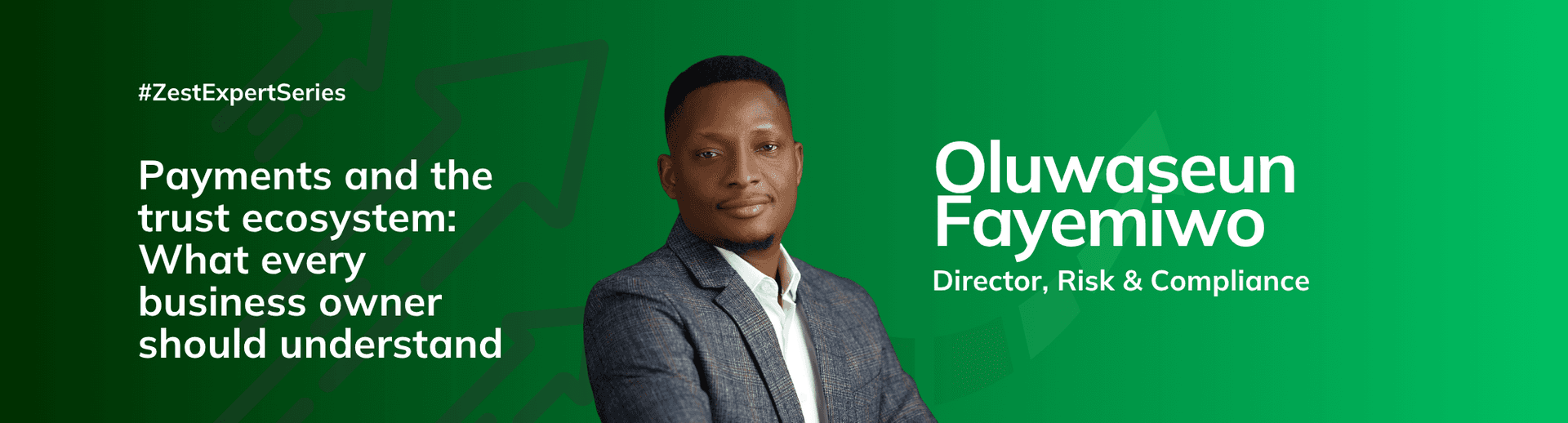
This edition of the #ZestExpertSeries explores a reality many businesses are already experiencing: payments are no longer just about completing transactions. They now shape customer experience, business growth, and trust and business owners need to understand the attendant complexities that come with them.
In this article, Oluwaseun Fayemiwo, Director, Risk & Compliance at Zest, examines the relationship between payments, fraud, and trust in today’s digital economy. He breaks down the opportunities digital payments create for businesses, the risks they entail, and the practical responsibilities merchants must take seriously to protect customers, reduce fraud exposure, and build long-term credibility.
Keep reading Seun's POV.
Across Nigeria today, one thing is clear: customers are changing.
Consumers are becoming more informed, more digital, and more demanding. They want convenience, speed, safety, and flexibility in how they pay. Whether they are buying food on Instagram, paying for services via mobile apps, scanning QR codes in‑store, or sending money through USSD, payments are now a critical part of customer experience, not just a back‑office function.
For Nigerian merchants who truly mean business, this shift presents both an opportunity and a responsibility. Payments can help you grow beyond borders, but they also expose you to new risks. Understanding fraud and building trust are no longer optional; they are essential to sustainable growth.
Let us take a deep dive in.
Traditionally, payments were seen as the final step in a sale. Today, they are a strategic business tool. Modern customers want to pay anywhere (in the store, on a website, inside an app, or on social media), anytime (during the day or at night), on any device (phone, tablet, or POS), using different methods (cards, transfers, QR, or USSD).
Merchants that rely solely on paper cash payments risk losing customers, even if their product or service is excellent. Electronic payments allow your business to sell across states, across cities and across borders. An online store in Ibadan can serve customers in Abuja or Accra. A service provider in Lagos can receive payments from Diaspora customers. Payments remove geographical limitations and unlock new revenue streams.
Customers are more likely to complete a transaction when payment is simple, fast and familiar. Features like tokenisation make repeat payments easy and safe.
Beyond customer convenience, digital payments offer your business advantages that include reduced cash handling, reduced risk of theft, and easier reconciliation. These allow your business to focus more on growth and less on manual processes.
While electronic payments unlock growth, they also introduce new risks. Nigeria, like every other market, is not immune.
Some common risks include customers denying legitimate transactions, claiming non‑receipt or unauthorised use, and weak security on websites, apps, and POS devices, which can be exploited to expose sensitive data.
The impact of fraud goes beyond the immediate transaction value. Merchants may also be exposed to chargeback fees and penalties, increased processing costs, damaged reputation, potential suspension by payment providers, and loss of customer trust. In many cases, trust once lost is very hard to regain.
As a merchant, you play a critical role in maintaining this trust. Where possible, support authenticated payments and leverage transaction tokenisation for recurring customers. These methods significantly reduce fraud risk while still offering smooth customer experiences. Your responsibility also includes ensuring POS devices are secure and not tampered with, and protecting checkout pages from malware and skimming. A single weak link can compromise your entire payment flow.
Trust also depends on how you treat customers after payment. Ensure you deliver goods as described, meet delivery timelines, and offer transparent refund and dispute processes
Protecting Customer Data is critical to ensure customer trust. Do not collect cardholder PINs during in‑store payments, minimise the storage of payment data, and encrypt sensitive payment information. Data protection is not just a technical requirement; it is a trust obligation.
Fraud tactics evolve constantly. What worked last year may not work tomorrow. As a merchant, you should stay informed about payment security requirements, understand new payment methods and innovations, and be alert to emerging fraud trends. Awareness is a powerful defence.
No merchant operates alone in the payments ecosystem. Working with a credible payment service provider ensures:
Access to modern, secure payment infrastructure
Ongoing monitoring of transactions
Early detection and blocking of suspicious activity
Compliance with industry and scheme standards
At Zest, we view fraud prevention as a shared responsibility. We are deeply committed to protecting merchants and customers by adopting best‑in‑class technologies, tools, and procedures to monitor, detect, and block fraudulent transactions, while preserving a smooth customer experience.
Payments power modern commerce, but trust powers payments. Success in today’s digital economy requires:
Offering convenient and flexible payment options
Understanding and managing fraud risk
Protecting customer data
Partnering with trusted service providers
Merchants who embrace payments strategically, treat security seriously, and prioritise trust will not only survive but thrive in Nigeria’s growing digital marketplace.
Oluwaseun Fayemiwo leads the Risk and Compliance team at Zest Payments Limited, where he focuses on building balanced frameworks that protect the business while enabling growth. He has a quiet interest in helping companies navigate the complexities of evolving markets.