Client Stories

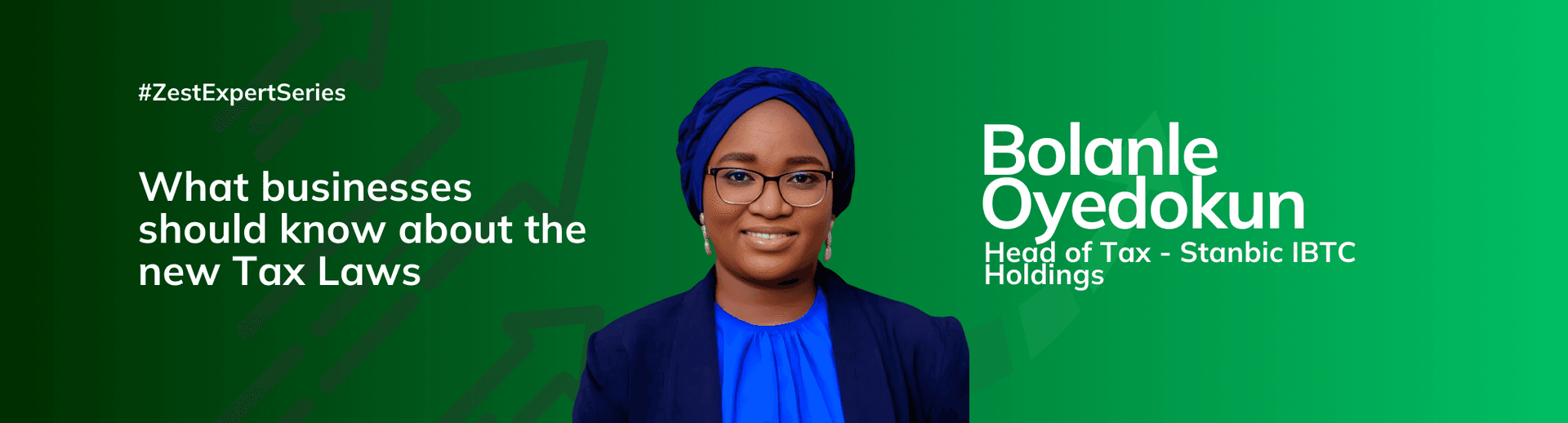
What businesses should know about the new tax laws with Bolanle Oyedokun, Head of Tax, Stanbic IBTC Holdings
Tax reform is rarely just a legal update. It reshapes how businesses operate, comply, and plan for growth. With the Tax Reform Bills enacted, the real question for businesses is what changes and what to do next.
In this article, Bolanle Oyedokun, Head of Tax at Stanbic IBTC, breaks down what the new tax laws mean in practical terms, from the consolidation of tax regulations to the renewed focus on Taxpayer Identification. She highlights what businesses, individuals, and foreign vendors must do to stay compliant and how to navigate the new Tax ID framework with confidence.
The Economic Stabilisation Bills, popularly known as the Tax Reform Bills, were signed into law by the President on Friday, 26 June 2025. The laws include the Nigeria Tax Act (NTA), Nigeria Tax Administration Act (NTAA), Nigeria Revenue Service Act (NRSA) and the Joint Revenue Board Act (JRBA).
The NTA repeals certain existing tax laws and consolidates the legal framework governing taxation in the country into a single legislation for simplicity and improved tax administration.
The NTAA provides a uniform procedure for the consistent and efficient administration of tax laws, facilitating tax compliance by taxpayers and optimising tax revenue.
The NRSA repeals the Federal Inland Revenue Service (Establishment) Act, No. 13, 2007, and establishes the Nigeria Revenue Service.
The JRBA established the Joint Revenue Board (JRBA), empowered to maintain and integrate a database of Taxpayer Identification Numbers (TIN) for every taxable person in Nigeria. The establishment of the Tax Ombud, which is expected to act as an independent arbiter between taxpayers and the Revenue Authorities, is another notable introduction by the JRBA.
The following are what you need to know about Taxpayer Identification (Tax ID) in line with the Acts.
The NTAA requires every taxable person (corporate, individual or business) to register with the relevant Tax Authority and obtain a Taxpayer Identification (Tax ID) for the purpose of complying with tax laws. This is also applicable to every Ministry, Department, or Agency of the Federal, State or Local Government.
The NTAA also mandates a person/entity engaged in banking, insurance, stockbroking, or other financial services in Nigeria to make the provision of a Tax ID a precondition for opening a new account or operating an existing account.
Every individual and corporation using their accounts for business purposes has always been required to provide a Tax ID for the purpose of running their accounts, before the enactment of the new Acts.
Every foreign vendor that supplies taxable goods or services is also required to register and obtain a Tax ID as mandated by the NTAA. However, a non-resident person/entity who derives only passive income from investment in Nigeria is not required to register for tax but is expected to provide information as may be required by the Service.
Further to the Tax ID requirement, the Joint Revenue Board (JRB) issued information on how to retrieve the Tax ID for individuals and corporate entities on taxid.jrb.gov.ng or taxid.nrs.gov.ng. Individuals can now retrieve their Tax ID using their National Identification Number (NIN), while companies can obtain theirs by using their Registration Number (RC) or Business Number (BN) as the search criteria.
Visit the official portal for the Nigerian Tax ID Portal at taxid.jrb.gov.ng or taxid.nrs.gov.ng
Click on the "Individual" tab on the homepage
Choose retrieval method: Select National Identification Number (NIN) as the retrieval method
Input 11-digit NIN and click on retrieve Tax ID
Provide personal information: Enter first name, last name, and date of birth exactly as they appear on the NIN
Click "Submit" or "Continue", and the 13-digit Tax ID will be displayed on the screen
Visit the official portal for the Nigerian Tax ID Portal at taxid.jrb.gov.ng or taxid.nrs.gov.ng
Click on the "Corporate" tab on the homepage
Select the appropriate entity type, such as Business Name, Company, Incorporated Trustee, Limited Partnership or Limited Liability Partnership
Enter the CAC registration number of the entity
Click "Retrieve Tax ID", and the 13-digit TIN will be displayed
In conclusion, the newly enacted Tax Reform Bills mark a pivotal moment in Nigeria’s journey toward a more coherent, transparent, and technology-driven tax system. For individuals, corporations, and foreign vendors alike, obtaining and maintaining a valid Tax ID is now not just a legal requirement but a critical step toward full participation in the nation’s formal economy. The key for businesses and individuals is to proactively adapt, leveraging the new digital systems, staying informed, and ensuring compliance, to navigate this new tax landscape confidently and efficiently.
Bolanle Oyedokun is the Head of Tax at Stanbic IBTC Holdings, where she provides strategic tax advisory and oversight across the Group. She is an experienced Tax Accountant with a demonstrated history of working in the financial services industry. Bolanle is skilled in Banking, Financial Accounting, Tax Accounting and Inventory Management.